The Battle of Suomussalmi: Winter Warfare and Deadly Encirclement
When the Soviet Red Army invaded Finland in November 1939, Soviet military planners anticipated a swift victory within weeks. However, the Battle of Suomussalmi, fought between December 7, 1939, and January 8, 1940, completely shattered those expectations. Roughly 11,000 Finnish defenders, lacking heavy armor and air support, confronted approximately 45,000 Red Army soldiers from the 163rd and 44th Rifle Divisions. Soviet troops advanced along narrow, snowbound forest roads in eastern Finland, creating long, vulnerable motorized columns trapped between dense wilderness and sub-zero temperatures.
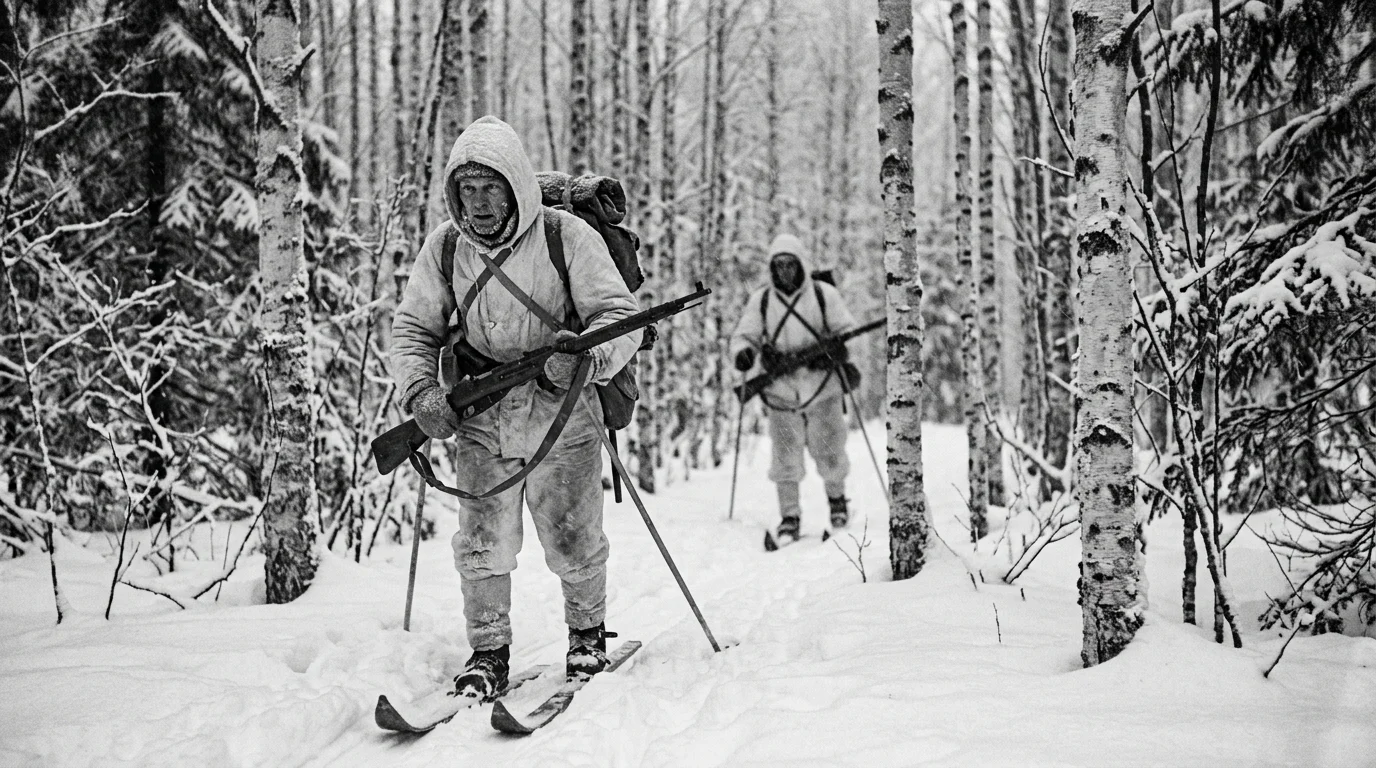
Finnish commander Colonel Hjalmar Siilasvuo employed innovative “motti” tactics—a Finnish word referring to firewood logs bundled for chopping. Highly mobile Finnish ski troops, clad in white camouflage suits, silently moved through the thick snow, striking the exposed Soviet columns at multiple points. By severing communication lines and blocking roads with felled trees, the Finns broke the massive Soviet forces into isolated pockets. The Finns then systematically destroyed these immobilized pockets using hit-and-run strikes, intense sniper fire, and localized mortar bombardments, leaving Soviet soldiers exposed to freezing temperatures reaching minus 40 degrees Fahrenheit.
The battle resulted in catastrophic Red Army casualties, with an estimated 13,000 to 27,000 Soviet soldiers killed or missing, alongside massive equipment losses including tanks and field guns. In contrast, Finnish casualties totaled approximately 2,700 men, with roughly 900 killed. Beyond boosting Finnish morale, the disastrous Soviet performance at Suomussalmi sent shockwaves across Europe. Observing the Red Army’s logistical paralysis and tactical incompetence, Adolf Hitler concluded that the Soviet military was a house of cards that would crumble instantly under a German invasion, accelerating his strategic planning for Operation Barbarossa in 1941.