3. The Pig War of 1859
History often turns on grand ideologies, but sometimes it pivots on a single farm animal. In the summer of 1859, the United States and the British Empire nearly went to war over a dead pig. The conflict centered on the San Juan Islands, a small archipelago nestled between Washington State and Vancouver Island. The Oregon Treaty of 1846 had established the 49th parallel as the border between American and British territories, but vague geographical wording left the ownership of the San Juan Islands fiercely disputed.
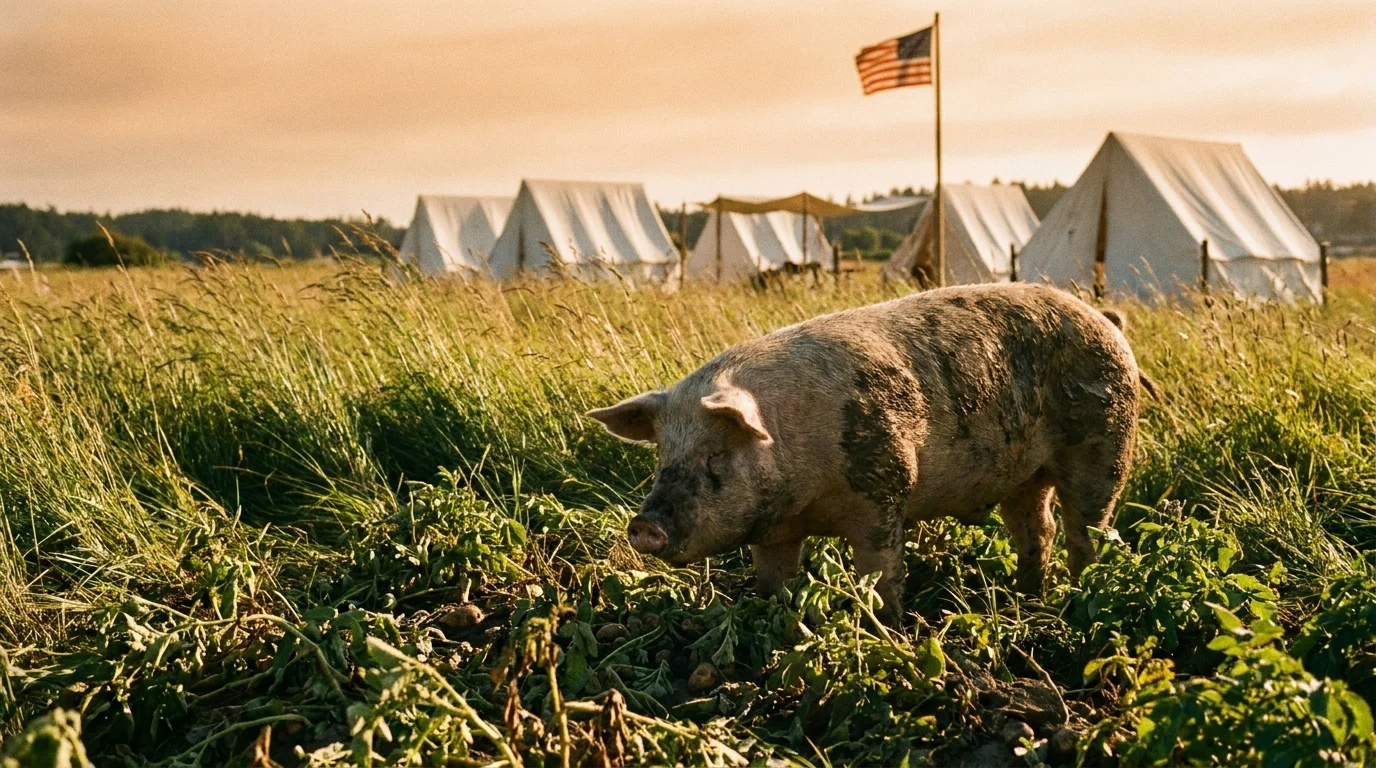
Both American settlers and employees of the British Hudson’s Bay Company occupied the island. On June 15, 1859, an American farmer named Lyman Cutlar found a large black pig rooting through his potato patch. Frustrated, Cutlar shot and killed the animal. The pig happened to belong to Charles Griffin, an Irishman working for the British company. When British authorities threatened to arrest Cutlar, the local Americans called for military protection.
The situation escalated with absurd speed. The concept of Manifest Destiny—the widespread 19th-century belief that American expansion across the continent was both justified and inevitable—fueled the American commanders. Captain George Pickett (who would later lead the disastrous Pickett’s Charge at Gettysburg) landed on the island with a detachment of infantry. The British responded by sending heavily armed warships. Within weeks, 461 Americans stood ready to fight 2,140 British troops and five warships.
Fortunately, cooler heads prevailed. British Rear Admiral Robert L. Baynes refused to engage his forces, famously declaring that two great nations fighting a war over a squabble about a pig was foolish. Both sides agreed to a joint military occupation that lasted 12 years until an international arbitrator peacefully awarded the islands to the United States. Today, it stands as a bizarre and bloodless testament to the dangers of diplomatic miscommunication.