6. The Transistor: The Tiny Brain Behind the Digital Revolution
If you reach into your pocket and pull out a smartphone, you are holding billions of the most consequential American inventions ever created: transistors. Before 1947, electronic devices like radios and early computers relied on vacuum tubes. These glass bulbs were bulky, generated massive amounts of heat, and burned out constantly. The famous ENIAC computer, built during World War II to calculate artillery trajectories, required 18,000 vacuum tubes and took up an entire room.
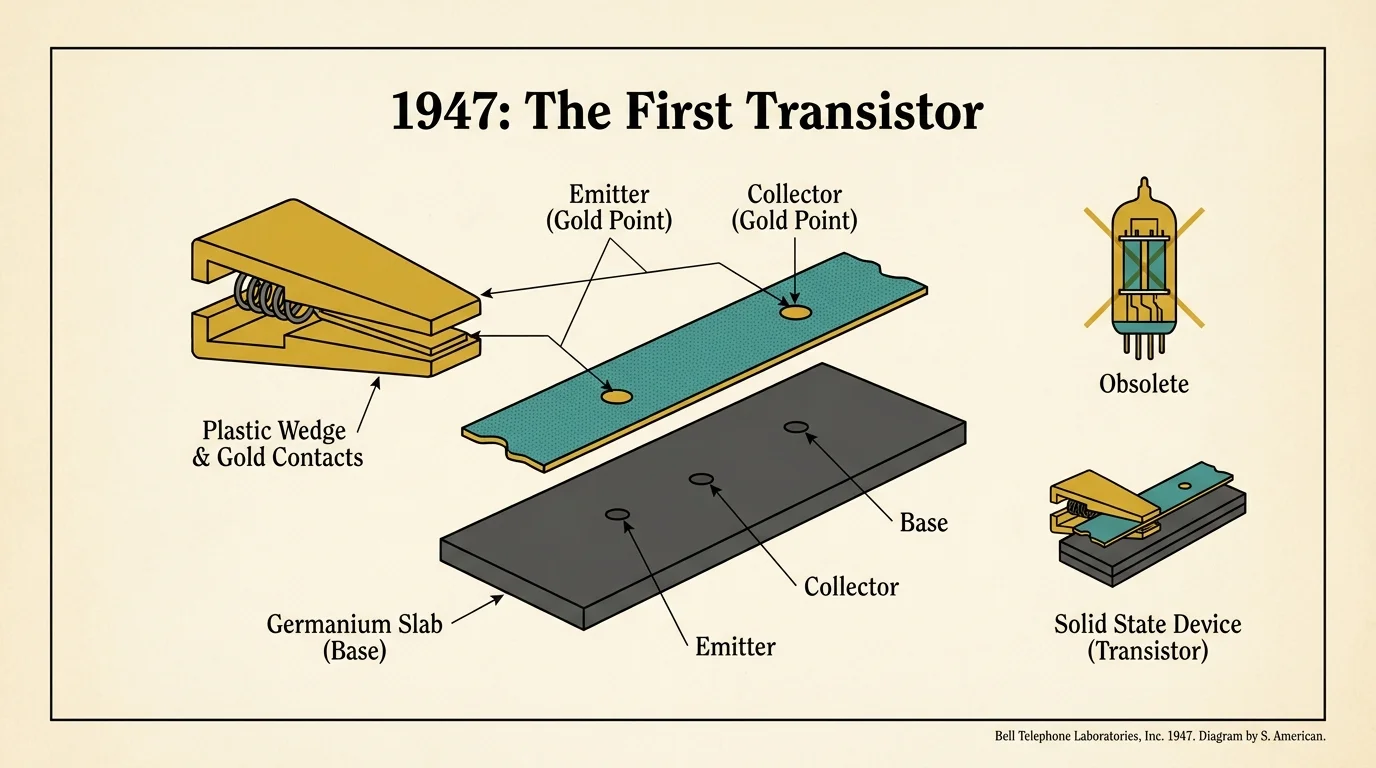
At Bell Laboratories in New Jersey, physicists John Bardeen, Walter Brattain, and William Shockley sought a solid-state alternative. By placing gold contacts on a crystal of germanium, they created a device that could amplify and switch electrical signals without the need for a fragile glass vacuum. They unveiled the first working point-contact transistor in December 1947.
The transistor made miniaturization possible. It allowed engineers to cram complex circuitry into incredibly small spaces, directly enabling the space race—because you cannot launch a room-sized computer to the moon. As companies found ways to etch multiple transistors onto a single piece of silicon, they birthed the microchip. This pivotal moment shifted the center of American innovation to a fruit-growing valley in California, soon to be renamed Silicon Valley. Every modern industry, from healthcare to finance, rests upon the microscopic shoulders of the transistor.