5. The Airplane: Defying Gravity at Kitty Hawk
Before 1903, the idea of heavier-than-air human flight belonged to myth and science fiction. Many brilliant engineers and well-funded scientists attempted to conquer the skies, only to fail spectacularly. Yet, the puzzle was solved by Wilbur and Orville Wright, two bicycle mechanics from Dayton, Ohio, who possessed no college degrees but possessed an unparalleled intuitive grasp of aerodynamics.
The Wright brothers approached flight differently than their predecessors. While others focused on building powerful engines, the Wrights realized that control was the true barrier to flight. Drawing inspiration from how birds angle their wings to maintain balance, they invented “wing-warping,” a system that allowed the pilot to steer the aircraft by twisting the wings. They built their own wind tunnel, meticulously compiling data on lift and drag that overturned decades of flawed aeronautical assumptions.
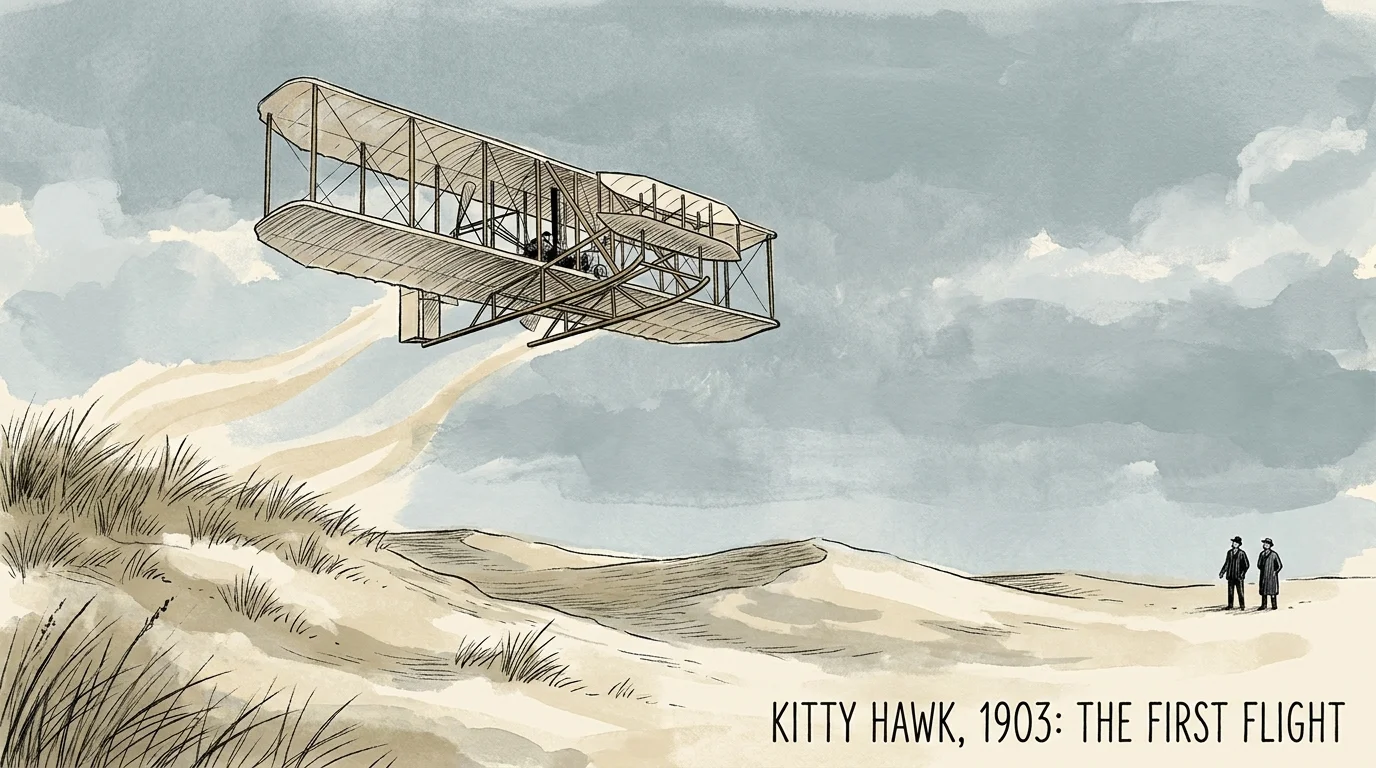
You can trace the birth of the modern world to the freezing, wind-swept dunes of Kitty Hawk, North Carolina, on December 17, 1903. Orville took the controls of their fragile wood-and-canvas Flyer. The aircraft lifted off the ground, flew for 12 seconds, and covered 120 feet. By the end of the day, Wilbur managed a flight of 852 feet. Within a decade, airplanes were being used in the terrifying new theater of World War I. Today, global commerce, international diplomacy, and modern tourism rely entirely on the foundational principles discovered by two brothers in a bicycle shop.