2. The Telegraph: Shrinking the World with Wire
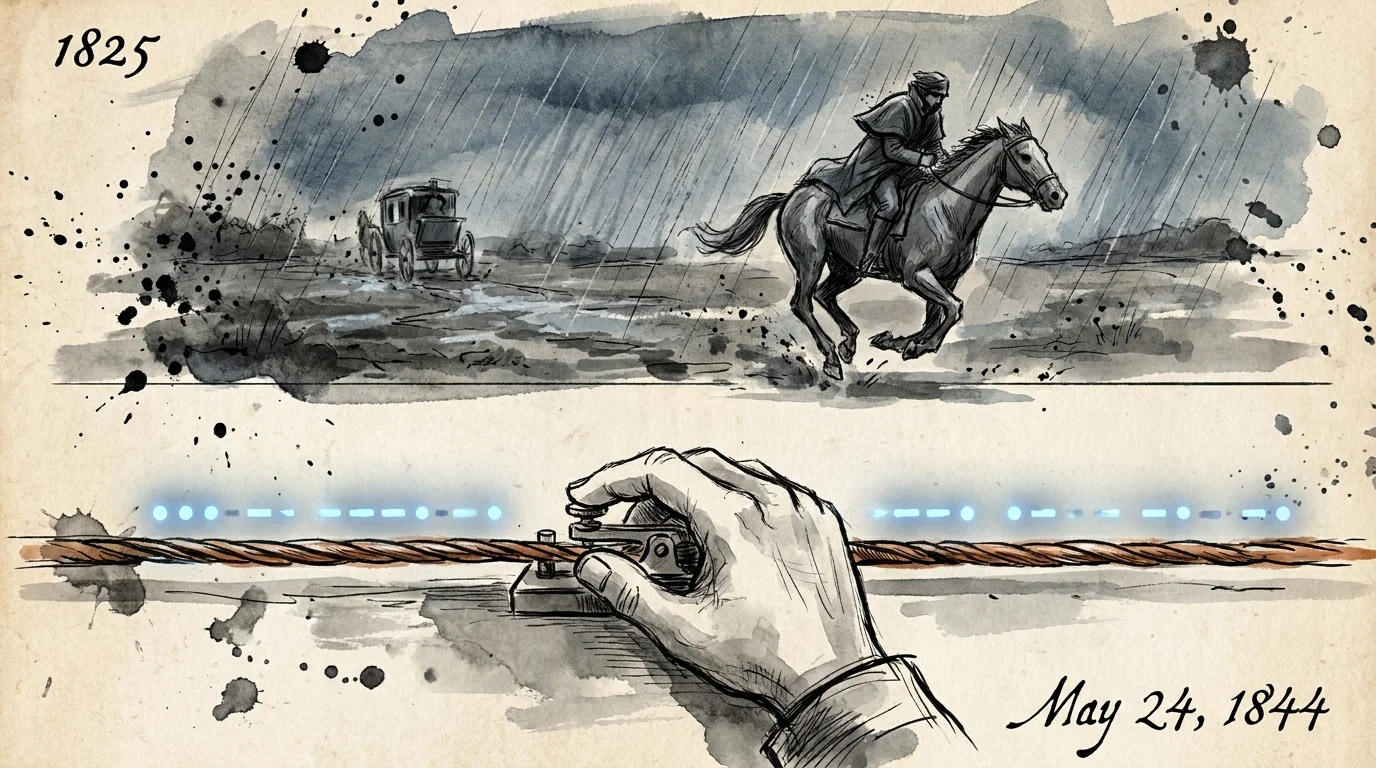
Imagine receiving news of a loved one’s passing days or even weeks after the tragedy occurred. In 1825, artist Samuel Morse was painting a portrait in Washington, D.C., when a horse messenger delivered a letter stating his wife was gravely ill in Connecticut. By the time Morse rushed home, she had already been buried. His crushing grief birthed a singular obsession: humanity needed a way to communicate instantly over long distances.
Morse did not invent electricity, but he successfully harnessed it for communication. Working with Alfred Vail, he developed a single-wire telegraph system and a revolutionary code of dots and dashes. This breakthrough culminated on May 24, 1844, when Morse sat in the U.S. Capitol and tapped out a message to Baltimore: “What hath God wrought.”
The telegraph profoundly transformed the American landscape. During the 19th century, the United States was aggressively pursuing “Manifest Destiny,” the belief that the nation was ordained to expand to the Pacific Ocean. Administering a continent-spanning republic seemed impossible when information traveled at the speed of a galloping horse. By 1861, Western Union had completed the first transcontinental telegraph line, instantly connecting the East and West coasts. During the Civil War, President Abraham Lincoln used the telegraph room in the War Department to communicate directly with his generals on the front lines, creating the first modern system of centralized military command. Morse’s invention laid the neurological pathways of the modern world.