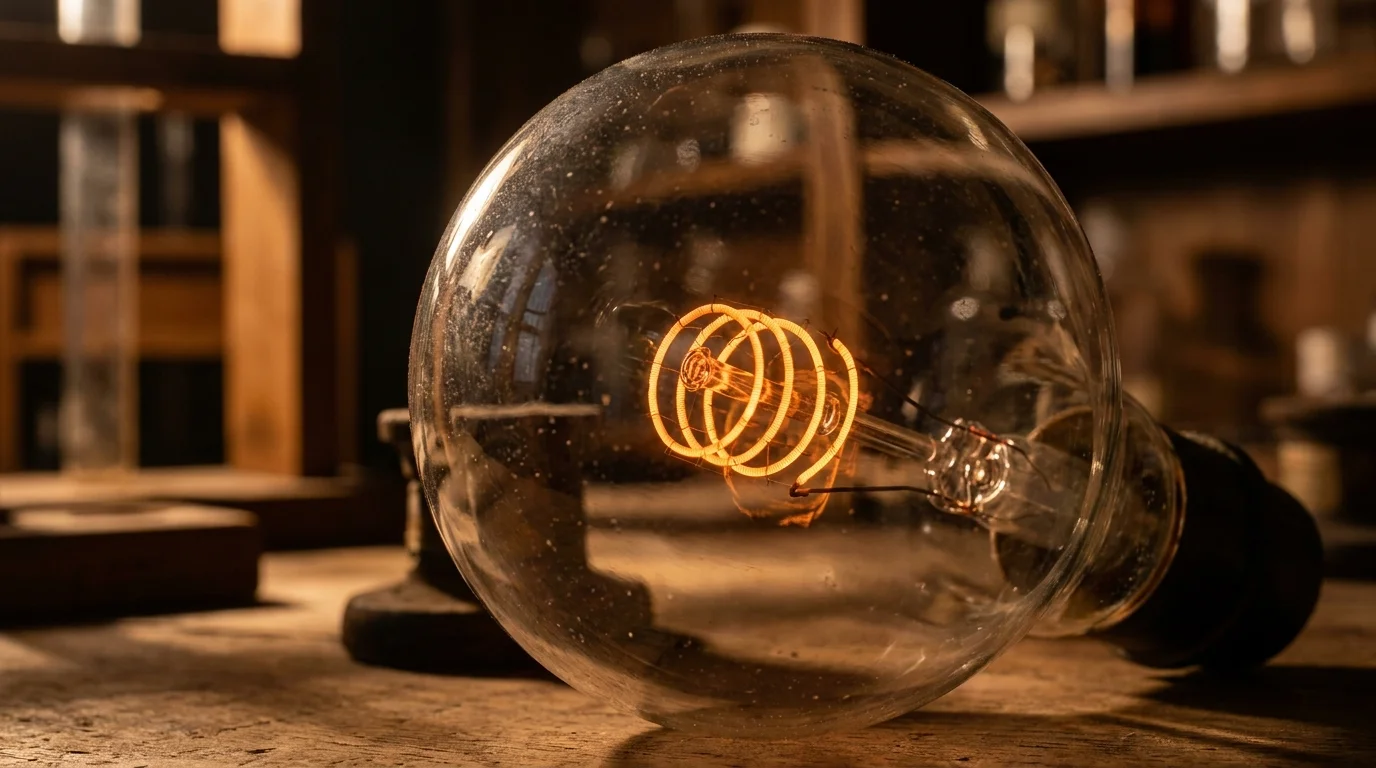
4. The Incandescent Light Bulb: Illuminating the Modern Age
For most of human history, society operated on a biological clock dictated by the sun. When darkness fell, work stopped, and people relied on dim, dangerous candles or gas lamps. Thomas Edison did not invent the first electric light, but he invented the first commercially viable, long-lasting incandescent light bulb, permanently banishing the night.
Edison’s true genius lay in his methodology. He established an “invention factory” in Menlo Park, New Jersey, creating the first modern research and development laboratory. Edison and his team of specialized engineers, machinists, and chemists tackled the light bulb problem systematically. They tested over 6,000 different plant materials to find the perfect filament. In October 1879, a piece of carbonized cotton thread burned for 13 and a half hours. By 1880, they had crafted a bamboo filament that lasted over 1,200 hours.
Edison knew a bulb was useless without a power grid. He subsequently engineered the entire infrastructure required to light up a city, from dynamos to electric meters. When the Pearl Street Station in New York began generating electricity in 1882, it ignited a global revolution. The light bulb created the 24-hour workday, transforming factory labor and paving the way for the vibrant, neon-soaked nightlife of modern metropolises. You cannot understate this shift; Edison effectively doubled the active hours of human existence.