
You interact with the legacy of American ingenuity every single day. When you check your smartphone, flip on a light switch, or board a commercial flight, you rely on technological leaps that began as daring experiments in makeshift workshops. The story of American inventions history is not merely a timeline of clever gadgets; it is the unfolding narrative of a young nation attempting to conquer vast distances, solve impossible problems, and ultimately reshape human existence.
To understand how US innovations conquered the globe, you have to look at the unique environment that fostered them. In 1790, the United States Congress passed the first Patent Act. This legislation democratized innovation. You no longer needed royal patronage or immense wealth to protect your ideas; a simple mechanic or farmer could secure the exclusive rights to their creation. This legal framework, combined with an expanding frontier and a restless, ambitious population, turned the United States into a crucible for historic American tech.
Yet, the inventions changed world history in ways that were often unpredictable. Some innovations birthed new industries and brought people together across oceans. Others entrenched brutal economic systems or unleashed terrifying new weapons of war. Every great leap forward carries the weight of its consequences. Exploring the lives of these inventors USA gives you a front-row seat to the brilliance, the bitter rivalries, and the profound societal shifts that defined the American experiment.
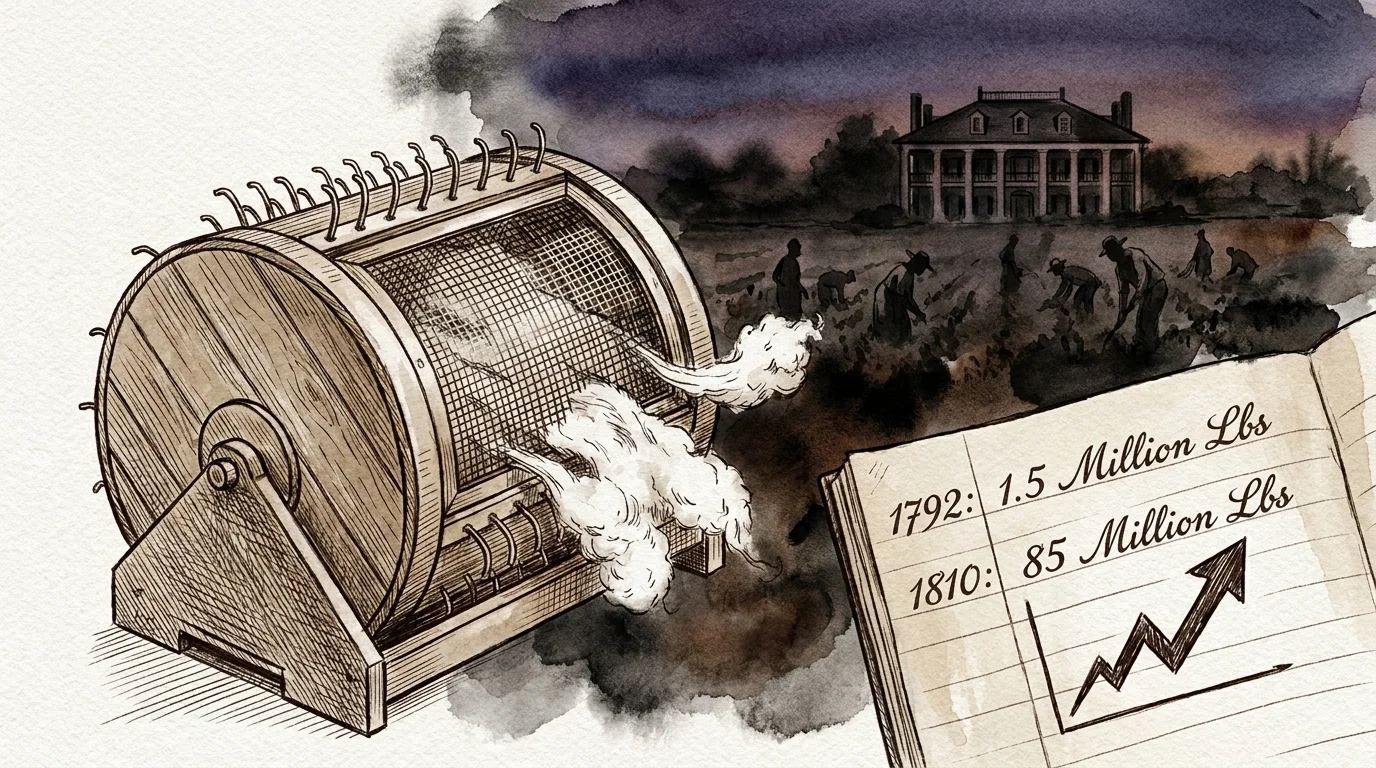
1. The Cotton Gin: An Engine of Wealth and Human Tragedy
When you think of inventions that changed the course of a nation, you must look at Eli Whitney’s cotton gin. In 1792, Whitney, a recent Yale graduate, traveled to a Georgia plantation to work as a tutor. He noticed a severe economic bottleneck: the American South had ideal soil for growing short-staple cotton, but separating the sticky seeds from the fluffy fiber by hand was painstakingly slow. A single enslaved person could only clean about one pound of cotton per day.
Whitney engineered a simple wooden drum with wire teeth that pulled the cotton fibers through a mesh, leaving the seeds behind. He patented the cotton gin in 1794. The impact was immediate and explosive. A small gin could process fifty pounds of cotton a day; larger water-powered models could process a thousand. By 1810, American cotton production skyrocketed from 1.5 million pounds to 85 million pounds annually.
However, this practical solution carried a devastating human cost. Before the gin, many American leaders believed chattel slavery—the brutal system of owning human beings as property—was slowly dying out because it was becoming economically unviable. The cotton gin reversed that trajectory overnight. To feed the voracious new gins, plantation owners required vast amounts of cheap labor. The invention cemented slavery as the foundation of the Southern economy, sparking a ruthless westward expansion to acquire more land and directly setting the stage for the American Civil War. The cotton gin serves as a stark reminder that technological efficiency does not inherently lead to moral progress.