5. Cleopatra Lived Closer to the Moon Landing Than to the Building of the Great Pyramids
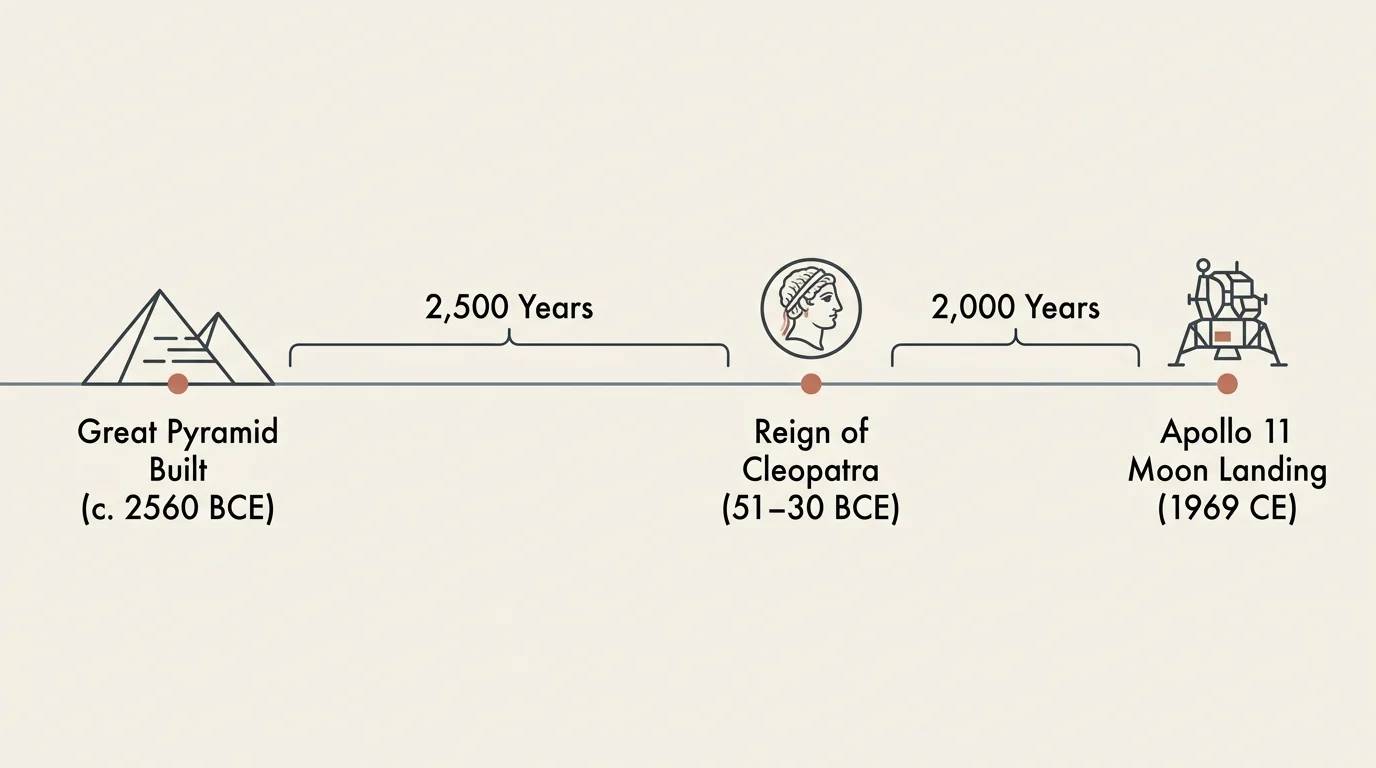
Popular culture often presents ancient Egypt as a single, static historical epoch, blending pharaohs, mummies, and monuments into one distant past. In reality, Egyptian civilization spanned such an enormous duration that Cleopatra VII lived significantly closer in time to the 1969 Apollo 11 Moon landing than to the construction of the Great Pyramid of Giza. Builders completed the Great Pyramid under Pharaoh Khufu around 2560 BCE, constructing a monument that dominated the landscape for millennia. Cleopatra VII, the last active ruler of the Ptolemaic Kingdom of Egypt, died in 30 BCE—roughly 2,530 years after workers laid the final stone of Giza’s largest pyramid.
When Neil Armstrong stepped onto the lunar surface on July 20, 1969 CE, less than 2,000 years had elapsed since Cleopatra’s death. This shocking chronological gap means that Cleopatra studied the Great Pyramids as ancient historical relics in much the same way you study ancient Rome today. Recognizing this vast expanse of time changes your perception of world history; it demonstrates that ancient Egyptian society was not a brief moment in time, but a continuous civilization that endured longer than all of modern Western history combined.