The Knocker-Upper: The Human Alarm Clocks of the Industrial Revolution
Before cheap mechanical alarm clocks flooded the consumer market, the Industrial Revolution created an unprecedented logistical nightmare: how do you get thousands of exhausted factory workers out of bed and to their shifts on time? The rigid demands of industrial capitalism could no longer rely on the rising sun or the crowing rooster. Factory owners penalized late arrivals with severe wage deductions, making oversleeping a catastrophic financial event for a working-class family. Enter the knocker-upper, a profession dedicated entirely to waking people up in the bleak, pre-dawn hours of urban Britain and Ireland.
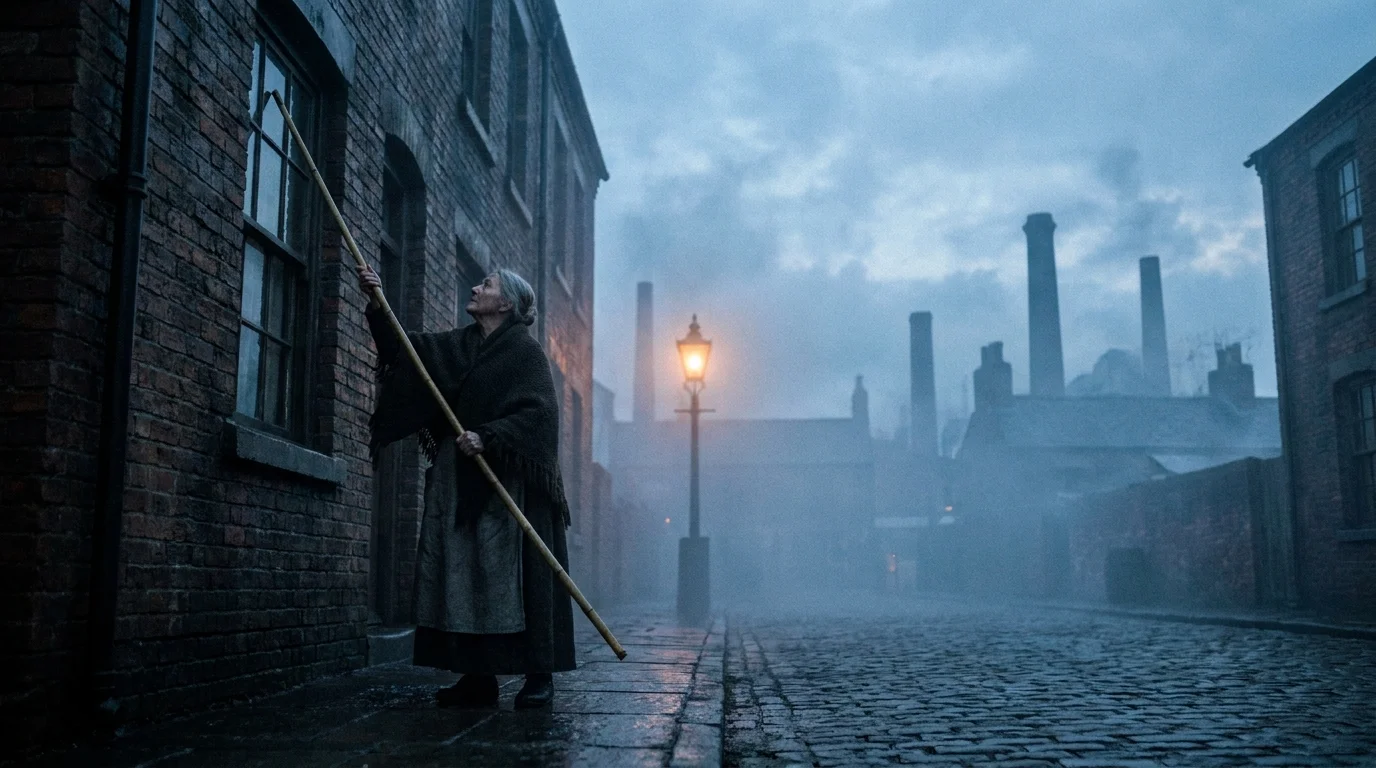
You can picture the knocker-upper walking the cobblestone streets at three in the morning, armed with a long bamboo pole or a specialized truncheon. For workers living on upper floors, the knocker-upper used the long pole to tap gently on the bedroom window pane—just loud enough to wake the client, but soft enough not to disturb the neighbors who had not paid for the service. They did not leave a designated window until the client explicitly acknowledged them, ensuring the worker would actually get out of bed.
Some professionals adopted highly creative methods to achieve their early morning goals. Mary Smith, a famous knocker-upper in East London, revolutionized her trade by using a hollow tube to shoot dried peas at the windows of her clients. This technique provided a sharp, distinct clatter against the glass that proved incredibly effective at rousing deep sleepers. You might look at this through the lens of nostalgia, seeing a quaint, community-focused quirk of Victorian life, but the reality was grounded in severe economic necessity. The workers desperately needed the wages, and the knocker-upper provided a crucial, paid service that kept the industrial machine grinding forward.
These human alarm clocks operated well into the 1920s and, in some northern English mill towns, survived until the 1950s. The widespread availability of affordable, reliable electricity and cheap bedside alarm clocks eventually rendered the profession obsolete. Today, it stands as a prime example of how human labor once filled the gaps that rudimentary technology could not yet bridge, securing its place among the most fascinating weird jobs in history.