10. The Republic of Indian Stream Declares Independence
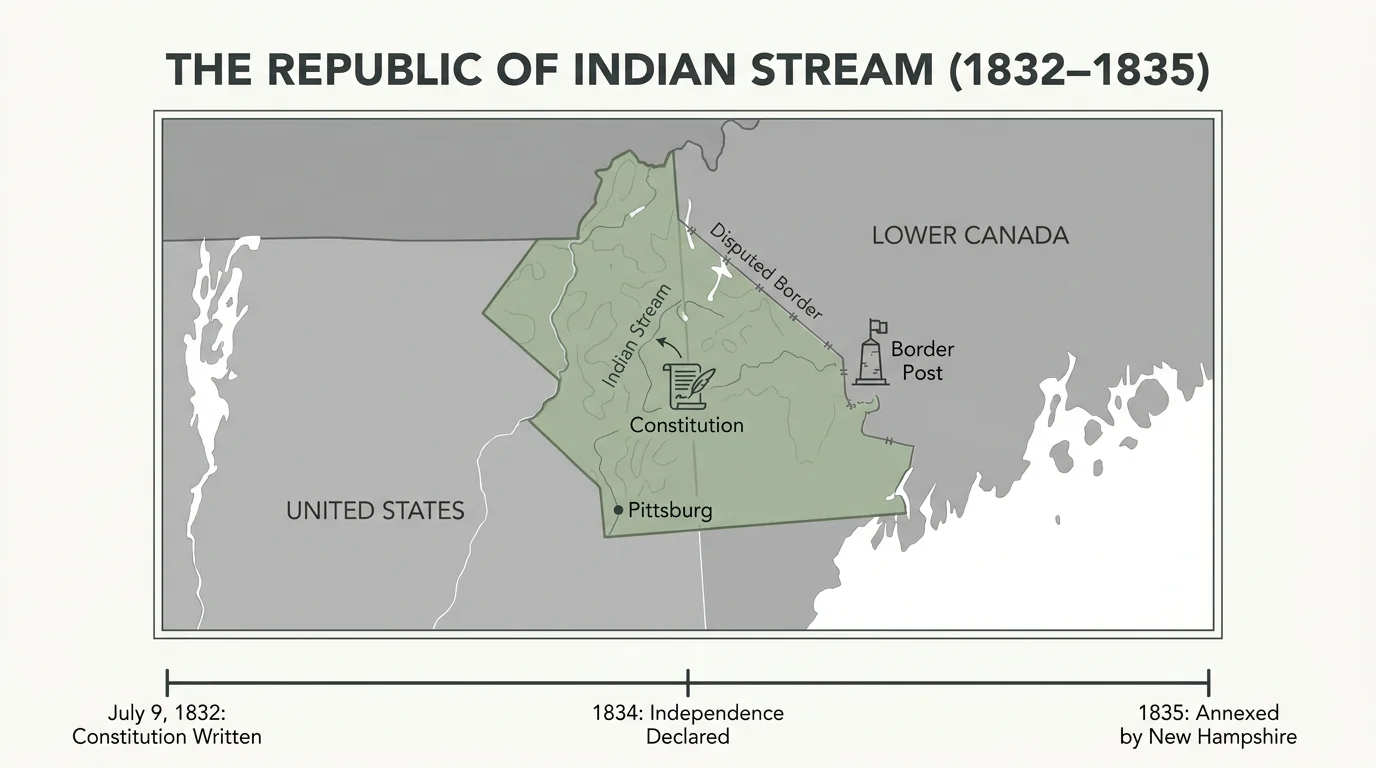
You probably assume that the borders of the continental United States were cleanly established by the federal government without local interruption. However, a small band of rugged settlers proved otherwise by creating their own sovereign nation in the remote wilderness. Following the Revolutionary War, the Treaty of Paris of 1783 utilized a highly ambiguous definition regarding the boundary separating northern New Hampshire and the British province of Lower Canada (modern-day Quebec). The treaty relied on the “northwesternmost head of the Connecticut River,” but multiple branches fit that description.
Caught in this disputed territory, the roughly 300 residents of the Indian Stream region suffered dual taxation and overlapping legal jurisdictions from both the United States and Great Britain. Frustrated by decades of diplomatic neglect, the citizens took radical action. On July 9, 1832, they formally declared their independence and established the Republic of Indian Stream. They wrote a comprehensive constitution, formed a bicameral legislature, created an independent court system, and even fielded a 40-man standing army.
This tiny nation operated successfully for three years, functioning exactly like a miniature version of the early United States. The experiment finally ended in 1835 when the New Hampshire militia marched into the territory and forcibly occupied it, eventually solidifying American control through the Webster-Ashburton Treaty of 1842. When you study the Republic of Indian Stream, you discover a profound truth about human organization: when central authorities fail to provide clear governance, local communities will inevitably build sovereign systems to fill the vacuum.