2. Ford Edsel: An Automaker’s Billion-Dollar Blunder
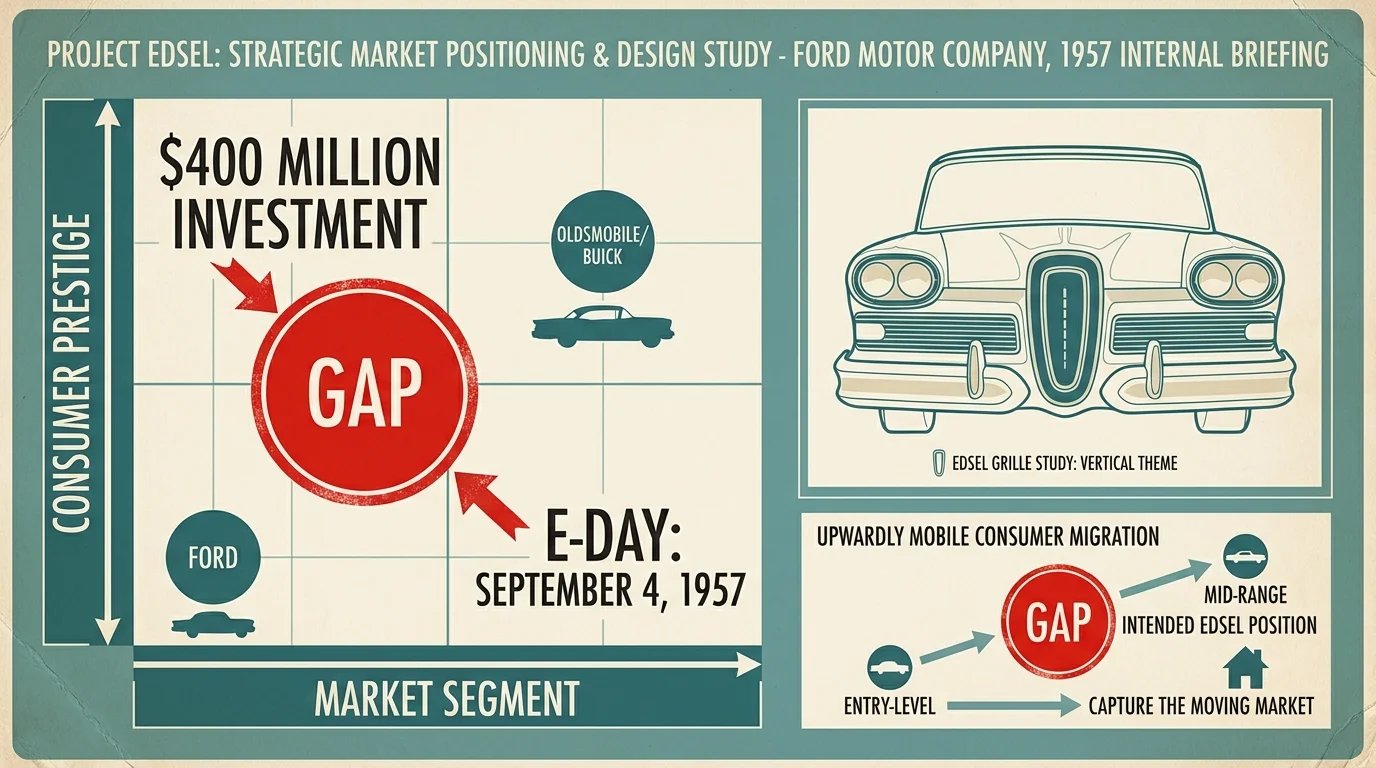
Following the conclusion of World War II, the United States economy experienced an unprecedented boom. Ford Motor Company noticed a troubling gap in its automotive lineup; upwardly mobile consumers were abandoning entry-level Fords and migrating directly to General Motors to purchase mid-range vehicles like Oldsmobile and Buick. To capture this lost revenue, Ford invested over $400 million—a staggering sum in the 1950s—into researching, developing, and marketing an entirely new division of automobiles. They named the car “Edsel” in honor of Henry Ford’s son, completely ignoring focus group data that suggested the name sounded harsh and unappealing to the public.
Ford relentlessly hyped the vehicle for an entire year before showing anyone a single photograph, promising an automobile that would define the future. When “E-Day” finally arrived on September 4, 1957, the public reaction was fiercely negative. The vehicle featured highly controversial styling, most notably a vertical front grille that critics famously described as looking like an Oldsmobile sucking a lemon. Beyond aesthetics, the Edsel introduced wildly experimental features like the Teletouch transmission, which placed push-button gear selectors directly in the center of the steering wheel hub. Drivers routinely destroyed their transmissions because they instinctively pressed the buttons thinking they were honking the horn.
Compounding these design failures, Ford launched the Edsel at the precise moment the American economy slipped into the recession of 1958. Suddenly, consumers prioritized smaller, more fuel-efficient cars over massive, chrome-laden luxury cruisers. Ford stubbornly produced the Edsel for three model years before finally shutting down the division in late 1959. The Edsel remains one of the most studied history facts in business schools, demonstrating that massive budgets and relentless marketing cannot save a product that ignores consumer research and completely misses the prevailing economic realities.